#concussion, #pcs, #tbi

TBI and Covid 19

The BIAUSA is hosting a webinar to discuss Covid, the vaccine, and TBI. There is recent reporting encouraging people with brain injuries to get vaccinated ASAP due to heightened threat of inflammation from the brain’s response to Covid.

I encourage everyone to sign up for this webinar- only the first 500 people will be accepted, so don’t delay.

https://register.gotowebinar.com/register/5696700998122987532

Stay safe, be well.

#concussion, #pcs, #tbi

A Whole New (Scary) World

As brain injury survivors, we are well versed on how life can change on a dime. One moment we can have a fully functioning brain, and the next, we don’t.  My moment occurred on the way to work one day. One moment I was sitting at a three way stop, and the next, my brain was shaken in a forward and back trajectory from being hit from behind.  A seemingly innocuous accident that forced me to retire from my beloved teaching career, and still plagues me with symptoms and limitations, almost 9 years later.

But I digress, as TBI patients often do.  On March 13, 2020,  I feel like life changed in an abrupt, dramatic fashion.  On that day, President Trump issued a state of emergency for the USA because of the Covid-19 virus.  Life looks different today, almost two weeks later.  Schools in Pennsylvania are closed until at least mid-April, (some states have already canceled for the remainder of the year), and all non-life-sustaining businesses are closed.  Life, all of a sudden, feels very heavy, and looks very different.

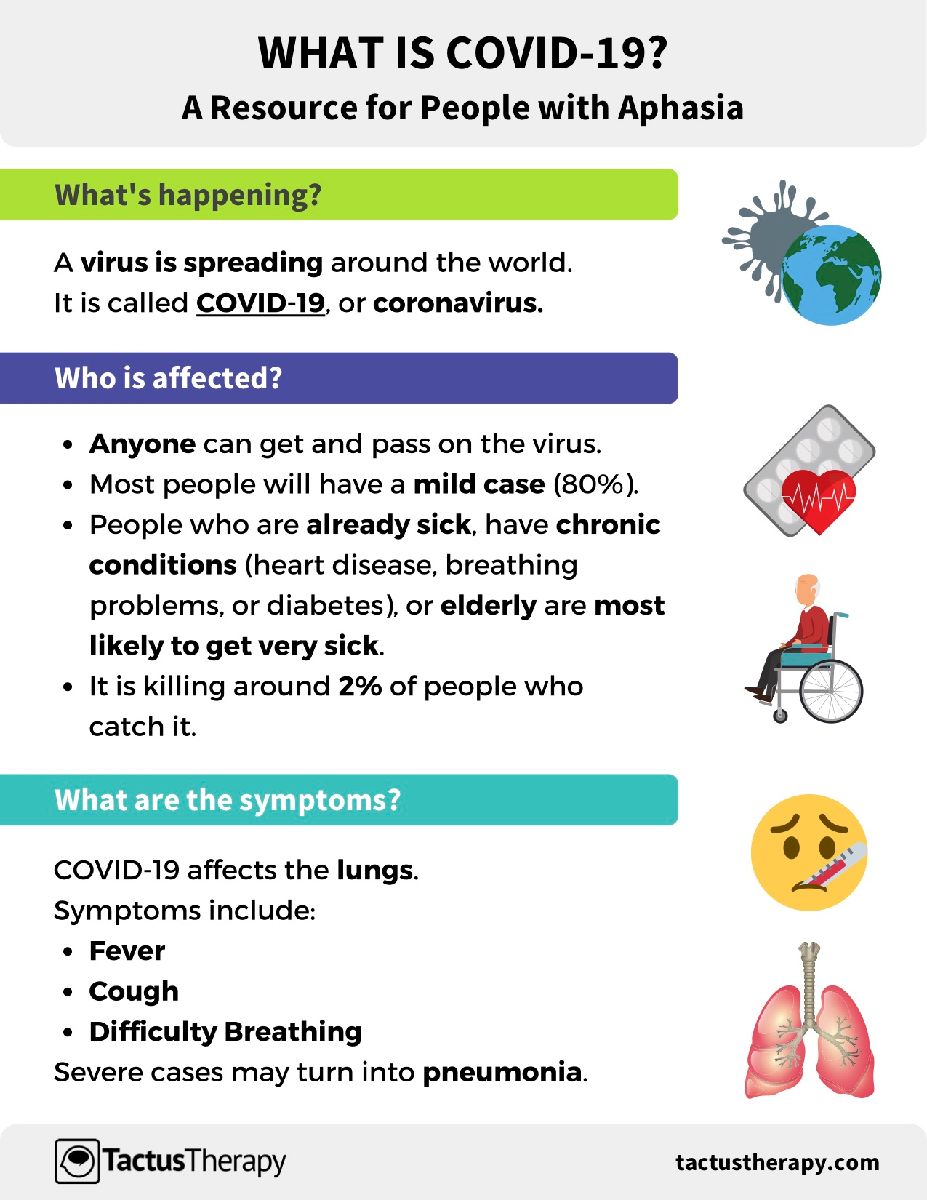
So what does this have to do with TBI patients? Well, actually, a lot. TBI patientsare already high-risk for comprehension and memory issues, as well as anxiety and depression.  First and foremost, it is important for everyone, even the patients with decreased cognitive ability, to understand the Covid-19 virus to the best of their ability.  The Brain Injury of Pennsylvania put out this resource to help patients with aphasia understand the virus.

Memory issues also come to play for individuals, especially when leaving the house. Guidelines tell us to repeatedly sanitize and wash hands for 20 seconds at a time.  Those with more significant memory issues may not remember to do this as often as necessary, therefore possibly spreading the virus further.  Many TBI patients, myself included, manage multiple medications per day. Poor planning of requesting refills (and sometimes limited resources) may result in days of missed doses due to doctor and pharmacist’s limited hours. During this time when all citizens are being urged to stay home as much as possible, some pharmacies and drug programs have waived the early refill limits to allow for patients to ensure their medications are not missed.

design

And perhaps the most applicable problem for TBI patient is the increase in levels of anxiety and depression. It is well documented that side effects of TBI include mood disorders such as rapidly changing moods, anxiety, and depression.   Personally, anxiety has been my biggest struggle during this crisis.  I do not do well with the unknown.  My family will attest that I like to have a plan, and to know what to expect. This Covid-19 crisis has turned that all upside down, and my anxiety has increased.  While I do have rescue medicine to help when other methods fail, I always try to use other methods to calm myself down.  Recently, Harvard Medical School recommended yoga to deal with Covid-19 anxiety.  Fortunately, Love Your Brain is reworking their spring yoga classes to bring them digitally, along with meditation and community building activities.   I, personally, have been trying to use their breathing exercises to help with my anxiety-induced insomnia.  I look forward to completing some of their yoga classes at home.

This is tough, folks.  There is no doubt about that.  But when we don’t know what to do, it’s always best to just do. the. next. right. thing.  And right now, that next best thing is to just stay home– and breathe.

Be well.

#concussion, #pcs

More than “just a headache.”

Warning: political opinions ahead.

Recently, the president of the United States ordered air attacks which resulted in retaliatory missile attacks against our troops in Iraq. To date, 50 US service people have been diagnosed with Traumatic Brain Injuries. Instead of recognizing these injuries as serious, and potentially life-altering, the person who is in charge of these brave service members chose to minimize their diagnosis. To quote the president, talking about these soldiers, he said “I heard they had headaches and a couple of other things, but I can report that it’s not very serious.”

On the contrary, President Trump. The United States Defense and Veterans Brain Injury Center has written, “The high rate of TBI and blast-related concussion events resulting from current combat operations directly impacts the health and safety of individual service members and subsequently the level of unit readiness and troop retention. 

If The United States Department of Defense recognizes TBI as a very serious injury, shouldn’t the leader of our country? Shouldn’t he, at the very least, refrain from making such uninformed commentary?

*Insert knowing eye-roll*

At one time, we had a president who cared enough to be informed about an issue before he spoke. Back in 2014, President Obama said, “I’ve seen in my visits to wounded warriors [that] traumatic brain injury is one of the signature issues of the wars in Iraq and Afghanistan.” That year, the US, along with the NCAA committed 30 million dollars for concussion research- research that is going to help care for these newly wounded soldiers.

The National Institute of Health recognizes that there is no such thing as a “mild” traumatic brain injury. If only the person in charge of our troops did. The Veterans of Foreign Wars group is demanding an apology for Trump’s erroneous comments. I hope they receive it.


#concussion, #pcs

When the words won’t come…

So many words…

The irony of how often I have to communicate my misunderstandings, or shortcomings from my brain injury, is not lost on me. With brain injuries, a lot of people, myself included can suffer from aphasia. The best way I can explain aphasiato those who don’t know, is to imagine you had to step back into a library in the 1980’s. Now imagine that you have a school assignment to complete. You will have to find five facts from three different resources. And you may only use the materials available at this 1980’s library, and you will be utilizing the card catalog and working with the Dewy Decimal System.

Now imagine at the same time, your friend has been given the same assignment, but they are allowed to use their iPhone, iPad, and school computer to do their research.

How much sooner would the answers be found with the streamlined technology? Almost as quickly as they typed in a question, they would receive answers.

However, you would be at the mercy of sifting through the card catalog- then having to find and vet sources. While both methods may eventually, lead to success- I think it is clear that the streamlined- digital method for finding information could be MUCH faster.

My brain, once, was the streamlined, tech-savy expert on words and the thoughts that I wanted to express. And then one day, my brain became the equivalent of a kindly, old librarian who lives in my head and has access to all of the files of information I have. Now, each time I so much as want to say a word- the librarian gets scooting along- as fast as possible- in order for me to be able to say each sentence. And sometimes, when I just can’t complete my thoughts- the librarian came up short. Often times, the more that is going on around me, the slower that librarian can work – leading to more incomplete thoughts and un-found words- and DEFINITELY more frustration on my part.

That is what it is like to live with a #tbi and #aphasia. So if you see me and I have very few words for you- you can blame it on my librarian. She’s working her hardest.

#concussion, #pcs

So, What’s Your “Type”?

No, that’s not a pick up line to be used on your next foray into online dating, I am referring to the six different types of concussions. Beyond being classified as “mild” or “moderate” or “severe,” concussions also are now broken into “types” based on the patient’s symptomatic response.

The UPMC Concussion Clinic located in Pittsburgh, Pennsylvania is on the forefront of concussion research. They use the following graphic as an explanation of how they classify a concussion

Unfortunately, I qualified for all six clinical trajectories, and after years of therapy, only one of the classifications, Ocular, has really resolved itself. While this is an overwhelming realization, even 7+ years out, I do have the benefit of hindsight and I can see how different modalities of therapies helped to lessen my symptoms, and for that, I am grateful.

So, if you are suffering from a concussion or Post Concussive Syndrome, what’s your “type?” What has helped you? In the coming weeks, I will be sharing more about each classification and how it manifested itself in my life. I will also share the therapies and “tricks” that have helped me cope over the years. Maybe, if we put our collective heads together, we can all benefit.